Data center resource graph
This document describes the data center resource graph managed and validated by the DataCenterResource controller. It explains the design, the data model, how the graph is constructed, validated and some of the fields that are used to describe the graph.
Chantico is built on the foundation that physical and virtual components that
make up a data center can be related to each other. Each component that can be
monitored, aggregated or allocated energy-wise is represented as
a DataCenterResource custom resource. The relationships between these
resources define how energy flows from one resource to another. Together, the
resourcesand their relationships form a graph. Once the graph is completely
constructed, it allows for accounting all the energy usage in a data center.
One important property of the graph is that it is represented as a directed acyclic graph (DAG), meaning that there are no cycles in the graph. This is important because it allows for complete and unambiguous assignment of power consumption.
Fields and validation
| Field | Type | Description |
|---|---|---|
metadata.name |
string |
The name of the resource. This is used to reference the resource in spec.parents of other resources. |
spec.type |
string |
The type of the resource (e.g. PDU, bare metal, VM, pod) |
spec.physicalMeasurements |
list of string |
The list of physical measurements that are associated with this resource. A portion of these are the metrics that are relevant for energy usage calculation of this resource. |
spec.energyMetrics |
string |
Prometheus metric expression to collect energy usage |
spec.parents |
list of ParentRef |
Parent resources with optional coefficients |
spec.serviceId |
string |
The service ID that this resource is associated with. This is used to group resources together for energy accounting purposes. |
Some of these fields are validated by the controller to ensure that the graph is constructed correctly, has no ambiguous or unknown information, and that there are no cycles or invalid flags on the resources:
spec.typemust be one of the known resource types:pdu,baremetal,vm,kubernetesorheat. We expect to include more types in the future such as power feeds and input power types. Currently, if another type is used, the controller will not use the resource in energy usage calculations.spec.parentsmust reference existing resources in the same namespace and those resources must not (indirectly) refer to this resource. If a parent resource does not exist, the controller will not use the resource in energy usage calculations.spec.serviceIdmust not be set for a resource that is itself a parent of another resource. This is because the service ID is used to group resources that are provided to a services subscription, and this is not applicable to resources that are themselves split up into other resources. If, later on, we encounter a use case where this is needed, such as a PDU that is provided as a service on some outlets (for rack-as-a-service) but provided as a normal resource device for higher-level (baremetal, VM, kubernetes) resources, we may relax or extend this field.
Example graph
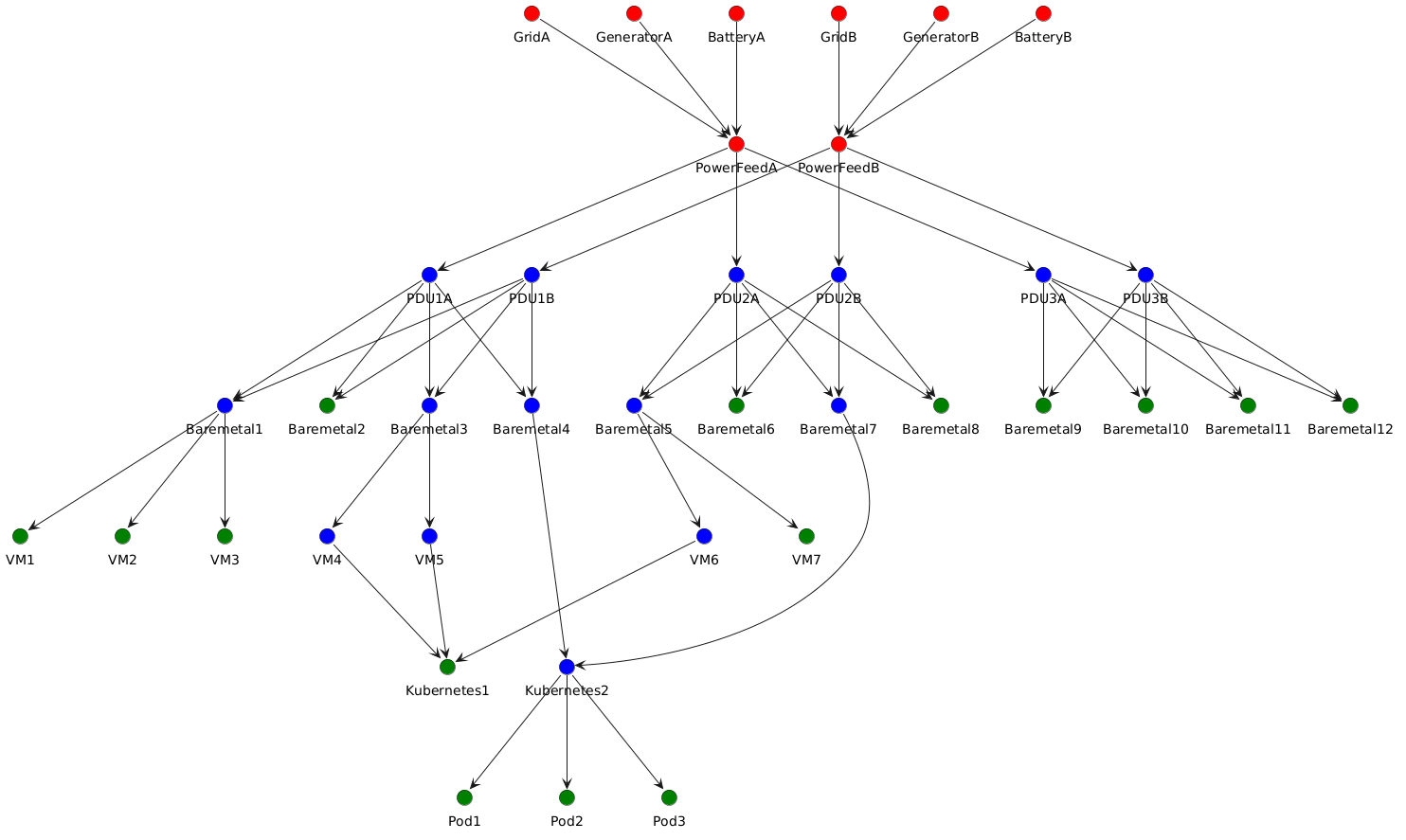
In the following graph, the nodes represent DataCenterResource custom
resources and the edges represent the relationships between them. The edges are
directed from parent to child, indicating the flow of energy from one resource
to another.
The red nodes represent input power resources (currently not yet implemented), the blue nodes represent resources that are not directly part of a service subscription (PDUs, bare metals, VMs, kubernetes clusters that are sold per namespace or pod, etc.), and the green nodes represent resources that are part of a service subscription (bare metals, VMs, kubernetes clusters, pods, etc.).
As such, the red nodes have no parents other than upstream power inputs, and the
green nodes have no children. The green nodes are marked with a serviceId in
their corresponding resources.
The red nodes are currently not implemented with specific types and fields, and the graph does not yet include any output power resources such as heat reuse. As such, this is an initial vision for the data center resource graph that Chantico managed and monitors.
Energy accounting
More details on the implementation of energy accounting with Prometheus recording rules can be found in the energy accounting document.